
Origin
Origin of Santa Muerte devotion
The origin of Santa Muerte devotion has no single date and no single founder. It is the result of many centuries in which different pieces came together: the gods of death of ancient Mexico, the Catholicism that arrived with the Conquest, the European image of Death with a scythe, and the faith of working-class neighborhoods. In 2001, a street altar in Tepito brought her into the open and turned her into a phenomenon.
Two stages: a long gestation and fast growth
The story of this devotion can be seen in two stages. The first is very long: it runs from pre-Hispanic times, through three centuries of colonial rule, up to the mid-20th century. During that time the ideas and images that make up Santa Muerte today blended together, almost without anyone noticing.
The second stage is short and fast. In the last decades of the 20th century, and above all since 2000, the figure took on her current appearance and spread throughout Mexico and beyond. Much of that growth happened among people living with poverty, marginalization or danger, who found in her a protector who does not shut the door on them.
Death in ancient Mexico
Long before the Spanish arrived, the peoples of Mesoamerica saw death as part of a cycle, not as an end. Just as day gives way to night and the rainy season to the dry season, life gave way to death, and death in turn fed life.
That idea was preserved in clay. In Tlatilco, in the Valley of Mexico, masks around three thousand years old were found showing a face split in two: one half with skin and the other without. They represent the duality found throughout ancient thought: the living and the dead, day and night, sun and moon.
A syncretic origin: the pieces that came together
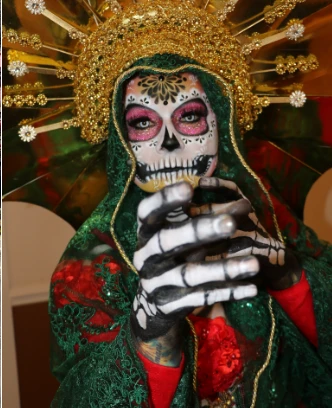
Scholars describe Santa Muerte as a syncretic figure, that is, one born from a mix of beliefs with different origins. These are the pieces most often mentioned:
- Mictlantecuhtli and Mictecacíhuatl. The lord and lady of Mictlán, the Mexica place of the dead. They ruled the realm of death together and received offerings. Their full story is on the page about Mictlantecuhtli and Mictecacíhuatl.
- The Maya god of death. The Maya also had a lord of the underworld, today often called Ah Puch. He was shown as a skeleton or a decaying body, sometimes with bells. His realm was Xibalbá, the underworld described in the Popol Vuh.
- The Day of the Dead. The ancient festivals for the dead merged with All Saints' Day and All Souls' Day, on November 1 and 2. That is where the custom of welcoming the dead with joy, food and music comes from, following the path of souls.
- The Christian "good death". In Catholicism, people ask God for a holy death: to die in peace and in his grace, having received the sacraments. The very name "Santa Muerte" (Holy Death) most likely comes from that request.
- Death in the Book of Revelation. In chapter 6 of Revelation, Death rides a pale horse, followed by Hades. In chapter 20, Death and Hades give up their dead for the final judgment.
- The European Death. Since the Middle Ages, Europe painted Death as a skeleton with a scythe and a robe. That image arrived with the Spanish and is the one people instantly recognize today in Santa Muerte statues.
- Images of the Virgin. Like the Virgin of Guadalupe and other images of Mary, Santa Muerte is dressed in mantles, crowned, prayed to with the rosary and brought flowers. Many devotees speak to her with the same affection one has for a mother.
Lords of the underworld in different cultures
Many cultures imagined a place for the dead and someone who ruled it. Some devotees see in these figures a single thread that leads to Santa Muerte. This table brings them together:
| Culture | Place of the dead | Who rules it |
|---|---|---|
| Maya | Xibalbá | The god of death (Ah Puch) |
| Mexica | Mictlán | Mictlantecuhtli and Mictecacíhuatl |
| Greek | Hades | Hades |
| Revelation | Hades | Death, who brings it along |
It should be said clearly: these similarities are interpretations. There are no documents proving that one figure turned into another.
The Conquest and a hidden devotion
The Spanish fought the ancient religions. For them only the God of the Bible existed, and any other belief was idolatry or the devil's work. Temples were torn down and images destroyed. It is also worth remembering that the peoples of Mesoamerica did not have the idea of a hell of punishment: the fate of the dead depended on how they died, not on their sins.
But the beliefs did not disappear completely. They blended with the new ones, hid inside them and stayed alive among the people. As early as the 1790s, Inquisition archives record Indigenous people in central Mexico worshipping a skeleton, as told in the history of Santa Muerte.
Legends about her appearance
Devotees pass along stories by word of mouth. The best known says that around the 1960s, in Catemaco, Veracruz, a man saw the figure of Santa Muerte drawn on the wooden boards of his house. He asked the village priest to recognize her, but the priest refused and called her the devil's work. Since then, the legend says, the devotion was passed on in silence, from person to person, for fear of being singled out.
Other versions place her spread in the state of Hidalgo in the mid-1960s. These stories are valuable because they show how devotees themselves explain their faith, but no documents confirm them. What is documented are the 18th-century Inquisition records, the prayers collected by anthropologist Oscar Lewis in the mid-20th century, and the Tepito altar of 2001.
From the home altar to the street
For much of the 20th century, Santa Muerte lived in private spaces: a corner of the living room, a shelf with a candle, a prayer card in a wallet. Prayers were learned from an aunt, a neighbor or a coworker. There were no temples or priests; each person related to her in their own way.
That form of devotion, with no intermediaries, explains much of its strength. You don't need anyone's permission or to belong to an institution to light a candle for her.
How it began: the origin of Santa Muerte devotion in Tepito
In 2001, Enriqueta Romero decided to put the image of Santa Muerte that her family kept out on the sidewalk in front of her home on Alfarería Street in Tepito. People began coming to leave flowers, candles and thanks. Over the years that altar became one of the best-known places of devotion in Mexico, and on the first day of every month devotees gather there to pray the rosary to her.
Following that example, other altars and chapels appeared in the capital and in other states. Images multiplied in markets, and the devotion began to show up in processions, tattoos and celebrations that bring together thousands of people. Her most important date is November 1, in the middle of the Day of the Dead season.
Why did it grow so fast?
Those who study the phenomenon usually point to several reasons:
- She does not judge. Many devotees feel that Santa Muerte does not ask them to be perfect before she will listen.
- She is close. People talk to her like a mother or a friend, with trust and without intermediaries.
- She treats everyone equally. Death comes the same way to rich and poor, and that makes her fair in the eyes of those who live at a disadvantage.
- She protects those who live at risk. At first she was sought mostly by people who risk their lives every day. Today people also ask her for health, work, protection for the family or to find something that was lost.
How she is depicted
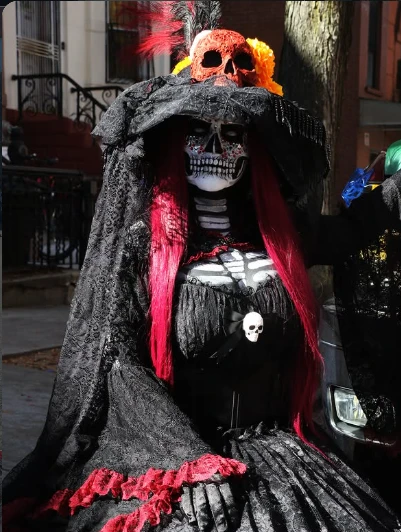
Santa Muerte can be shown with male or female features. In her sternest form she appears with a dark robe, a scythe and a rosary. In her most beloved form she is a lady dressed in a long white satin robe and a golden crown, like a bride or a queen. Many images also show her with a globe, a set of scales or an owl at her feet.
What her devotees believe
For many devotees, Santa Muerte is not a separate god or something opposed to God. They see her as a spiritual being created by Him, something like an angel, who carries out the hardest task of all: taking each person when their time comes. That power, they say, she receives from God and obeys Him. That is also why they consider her an intercessor who can plead on behalf of whoever asks her.
From that idea come the customs that devotees pass on:
- Ask for what is fair. Since death treats everyone equally, you do not ask her to harm anyone. You ask for what you need or what you consider fair.
- Keep your promises. You can offer her something in return for a favor: a candle, flowers, tidying her altar, singing to her, dressing her for a celebration or making peace with a relative. But it is said that it is better to promise nothing than to promise something and not keep it.
- Treat her like family. People talk to her out loud, leave her sweets and tell her their problems. The relationship is one of trust and affection, not fear, though always with respect.
- Ask for one thing at a time. Many advise not to mix requests: if you are asking her about love, do not start asking about money at the same time.
- Come clean and calm. It is recommended to clean the altar, wash your hands, pray without rushing and not do it under the influence of alcohol or drugs.
Her devotees insist that their faith is not witchcraft or Satanism. If you want to understand why so many people feel her as a mother, read why death is love.
Is she good or bad?
It is the question most often asked by those who don't know her. Her devotees answer that evil lies in people, not in her: Santa Muerte acts with justice and each person decides which path to follow. Some compare her to the angels, who have the power to do good and to punish, and who always act according to what is just.
The Catholic Church, on the other hand, rejects this devotion and asks the faithful not to practice it. This site does not take sides: it only describes how those who believe in her live their faith.
The names of Santa Muerte
Her devotees call her by many names, almost always with affection: Niña Blanca (White Girl), la Flaca (the Skinny Lady), la Santísima (the Most Holy), la Madrina (the Godmother), la Niña, la Huesuda (the Bony Lady) or Señora (Lady). Using a nickname is a way of being close; she is not spoken to as something distant, but as someone in the family.
Attempts to form a church
There were attempts to organize the devotion as a formal church. In 2003 Mexico's Ministry of the Interior granted registration to a religious association that venerated her, and in 2005 that registration was canceled. Since then the devotion has remained, above all, a popular and decentralized one: it has no central authority and no official book.
Keep reading
Read the full history of Santa Muerte, from ancient Mexico to today, or discover the most widely prayed Santa Muerte prayers.