
History
Santa Muerte history
Santa Muerte history blends Indigenous roots, the Catholic image of Death brought by the Spanish, and a folk devotion that stayed hidden for centuries and only came out into the street a few decades ago. Here you will find what is known from documents, and a clear note on what is still debated.
Santa Muerte history in brief
- Before the Conquest The Mexica (Aztecs) worshipped Mictlantecuhtli and Mictecacíhuatl, lords of Mictlán, the place of the dead.
- 16th–18th centuries In New Spain the Church uses the skeleton figure as a reminder that life comes to an end.
- 1793 and 1797 Inquisition records describe Indigenous people in central Mexico worshipping a skeletal figure, named in one of them as "Santa Muerte".
- Mid-20th century Anthropologist Oscar Lewis records prayers to Santa Muerte in Mexico City neighborhoods.
- 2001 Enriqueta Romero sets up a public altar in Tepito and the devotion moves from private homes to the street.
- Today There are devotees in Mexico, Central America and the United States; figures vary, but researchers speak of millions.
Roots: Mictlantecuhtli and Mictecacíhuatl, lords of Mictlán
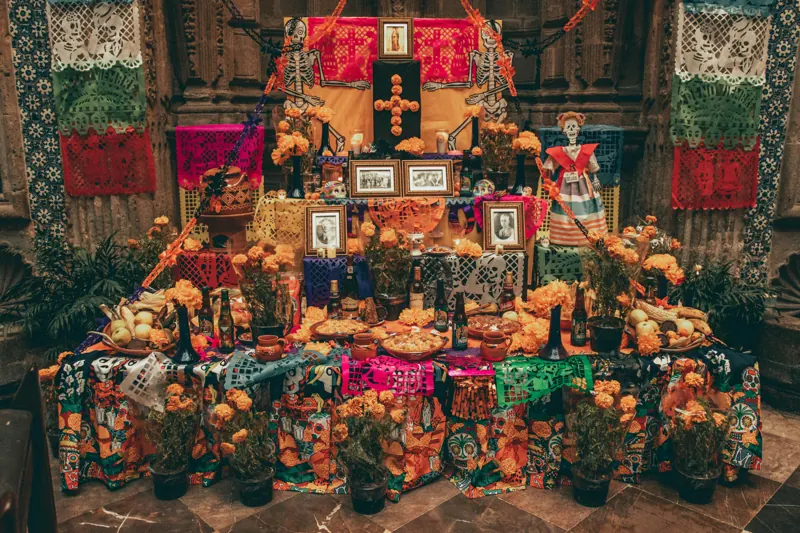
The Mexica worshipped Mictlantecuhtli and Mictecacíhuatl, lords of Mictlán, the place of the dead. He, the "lord of the place of the dead", was shown as a skeleton with bared teeth, accompanied by the owl, the bat and the spider. She, the "lady of the dead", watched over the bones of the departed and presided over the festivals the Mexica held in their honor.
To reach them, the soul of someone who died a natural death traveled for four years through nine regions full of trials: a river that could only be crossed with the help of a dog, mountains that crashed together, obsidian winds that cut like knives, and black waters. At the end, on the ninth level, Mictlantecuhtli and Mictecacíhuatl were waiting, and the soul could finally rest.
According to the Legend of the Suns, humanity itself was born from the bones kept by Mictlantecuhtli: Quetzalcóatl went down to Mictlán to ask for them and the gods gave them life with their blood. For the Mexica, life and death came from the same place. The full story is on the page about Mictlantecuhtli and Mictecacíhuatl.
Many devotees see Mictecacíhuatl as Santa Muerte's grandmother. It is worth being honest here: researchers such as Claudio Lomnitz and Katia Perdigón Castañeda point out that there is no evidence of a direct continuity between that ancient cult and today's devotion. The link is more a matter of cultural memory than of proven inheritance.
Death in New Spain
Spanish friars brought a very specific image of Death: a skeleton with a scythe, sometimes with an hourglass, which appeared in paintings, engravings and Holy Week processions. It was a reminder to live well, because the end comes for everyone.
That figure blended with Indigenous beliefs. In 1793, Franciscan friars in Pinal de Amoles, Querétaro, reported that some Indigenous people were worshipping an "idol" in the shape of a skeleton. In 1797, an Inquisition file about San Luis de la Paz, Guanajuato, mentions "Santa Muerte" by name. These are among the oldest written records known.
The 20th century: a hidden devotion
For almost two centuries Santa Muerte was venerated in private: on home altars, in prayers passed on by word of mouth, and in working-class neighborhoods of the capital. In the mid-20th century the American anthropologist Oscar Lewis recorded prayers to Santa Muerte among families in Mexico City.
2001: the Tepito altar
The turning point came in 2001, when Enriqueta Romero, known as Doña Queta, put a life-size image of Santa Muerte out on the sidewalk in front of her home on Alfarería Street in the Tepito neighborhood. It was one of the first public altars in Mexico City and became a gathering place for thousands of devotees.
From then on the devotion became visible: chapels, shops selling statues and candles, and huge celebrations appeared. The page on the origin of Santa Muerte devotion tells this in more detail.
Santa Muerte today
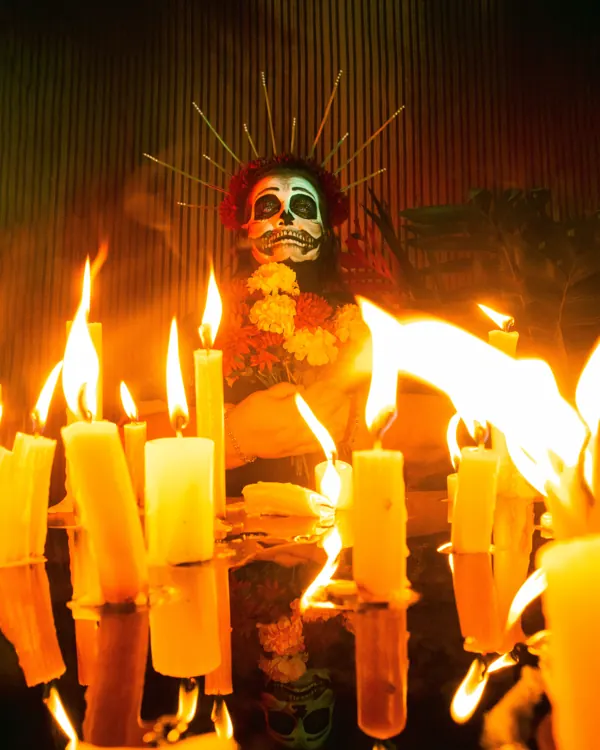
The devotion grew quickly in Mexico, Central America and the United States. Researcher R. Andrew Chesnut, author of Devoted to Death, has described it as one of the fastest-growing religious movements in the Americas. The number of devotees varies a lot depending on the source, so it is best to take the figures with caution.
The Catholic Church rejects this devotion and has said so on several occasions. Even so, many devotees consider themselves Catholic and pray to Santa Muerte with prayers taken from that tradition, such as the Our Father or the rosary.
Santa Muerte, the Catrina and San La Muerte are not the same
They are often confused, but they are three different things:
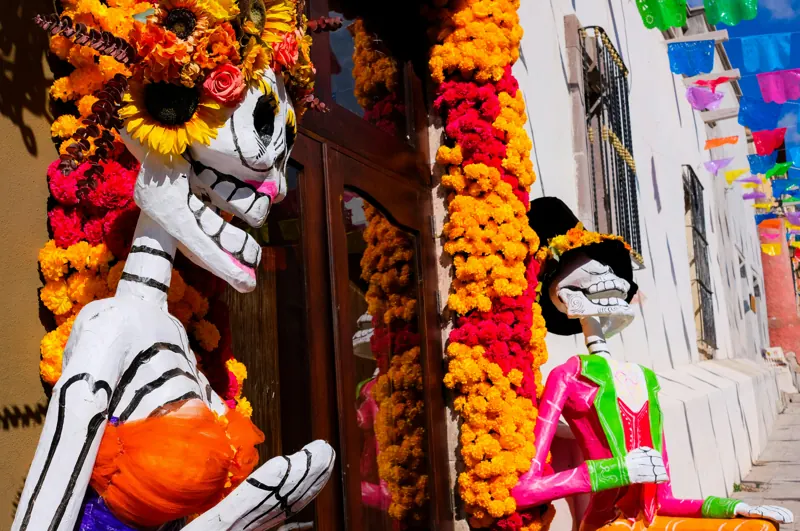
- The Catrina began as a cartoon. In the early 20th century the engraver José Guadalupe Posada drew an elegant skull to mock people who pretended to be what they were not, and Diego Rivera made her famous under the name Catrina. She is a Day of the Dead character, not a figure of devotion.
- The Day of the Dead is the November 1 and 2 celebration to remember departed family members. It is on UNESCO's list of Intangible Cultural Heritage and is celebrated by many people who have no connection to Santa Muerte.
- San La Muerte is a different devotion, from Paraguay and northeastern Argentina, especially Corrientes. He is shown as a male skeleton, often small and carved in bone or wood. He has his own history and his own feast days.
Keep reading
If you want to understand why so many people call her mother and protector, read why death is love. And if you want to start praying to her, here is the Santa Muerte novena, day by day.